Country
Costa Rica
Based on OECD Taxing Wages (2025 data), this page compares Costa Rica's modeled income tax, employee contributions, and take-home pay across the salary levels below. It is a standardized cross-country comparison, not a personal tax return, local tax quote, or average-income estimate.
Currency: CRC (Costa Rican Colon)
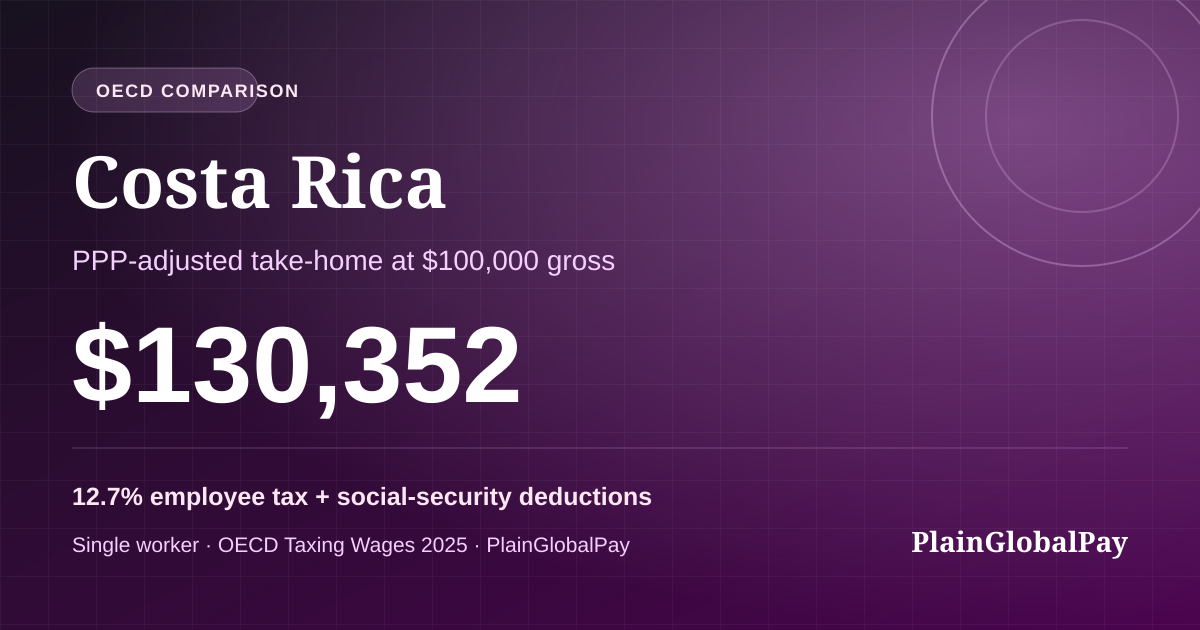
A $100,000 salary in Costa Rica returns about $87,327 in annual take-home pay after employee tax and social-security deductions of 12.7%.
Adjusted for purchasing power, that take-home is worth $130,352 in real terms, ranking Costa Rica #5 of 38 OECD countries (above the OECD average of $96,699). The effective income-tax rate is 2.8%. Figures from OECD Taxing Wages (2025 data) and the OECD PPP.
On PPP-adjusted take-home pay at a $100K gross salary, Costa Rica ranks #5 of 38 OECD countries, higher than 87% of them. It sits above the OECD average of $96,699.
Country
Costa Rica
Tax-data year
2025
Source
OECD
After income tax and employee social security contributions in Costa Rica.
USD, after income tax + employee SSC
The $100,000 gross splits into take-home pay, income tax, and employee social security contributions.
Single, no children · OECD Taxing Wages (2025 data)
| Gross (USD) | Net (USD) | PPP-Adj Net | Eff. Tax Rate | Employee tax + SSC |
|---|---|---|---|---|
| $20,000 | $18,030 | $26,913 | 0.0% | 9.8% |
| $30,000 | $27,045 | $40,370 | 0.0% | 9.8% |
| $40,000 | $36,060 | $53,827 | 0.0% | 9.8% |
| $50,000 | $44,811 | $66,889 | 0.5% | 10.4% |
| $60,000 | $53,204 | $79,418 | 1.5% | 11.3% |
| $70,000 | $61,408 | $91,663 | 2.4% | 12.3% |
| $80,000 | $69,862 | $104,282 | 2.8% | 12.7% |
| $90,000 | $78,594 | $117,317 | 2.8% | 12.7% |
| $100,000reference | $87,327 | $130,352 | 2.8% | 12.7% |
| $110,000 | $96,060 | $143,387 | 2.8% | 12.7% |
| $120,000 | $97,934 | $146,186 | 8.5% | 18.4% |
| $130,000 | $104,473 | $155,947 | 9.8% | 19.6% |
| $140,000 | $110,763 | $165,335 | 11.0% | 20.9% |
| $150,000 | $116,803 | $174,351 | 12.3% | 22.1% |
| $160,000 | $122,593 | $182,994 | 13.5% | 23.4% |
| $170,000 | $128,134 | $191,265 | 14.8% | 24.6% |
| $180,000 | $133,425 | $199,163 | 16.0% | 25.9% |
| $190,000 | $138,467 | $206,688 | 17.3% | 27.1% |
| $200,000 | $143,607 | $214,361 | 18.4% | 28.2% |
| $210,000 | $150,788 | $225,079 | 18.4% | 28.2% |
| $220,000 | $157,968 | $235,797 | 18.4% | 28.2% |
| $230,000 | $165,148 | $246,515 | 18.4% | 28.2% |
| $240,000 | $172,329 | $257,233 | 18.4% | 28.2% |
| $250,000 | $179,509 | $267,952 | 18.4% | 28.2% |
| $260,000 | $186,689 | $278,670 | 18.4% | 28.2% |
| $270,000 | $193,870 | $289,388 | 18.4% | 28.2% |
| $280,000 | $201,050 | $300,106 | 18.4% | 28.2% |
| $290,000 | $208,231 | $310,824 | 18.4% | 28.2% |
| $300,000 | $215,411 | $321,542 | 18.4% | 28.2% |
Local currency per 1 USD PPP – OECD PPP
| Year | PPP Factor | Exchange Rate | Price Level Index |
|---|---|---|---|
| 1990 | 50.6331 | N/A | 55.3 |
| 1991 | 62.5208 | N/A | 51.1 |
| 1992 | 73.9050 | N/A | 54.9 |
| 1993 | 78.8075 | N/A | 55.4 |
| 1994 | 87.2007 | N/A | 55.5 |
| 1995 | 104.4872 | N/A | 58.1 |
| 1996 | 119.2882 | N/A | 57.4 |
| 1997 | 132.0061 | N/A | 56.8 |
| 1998 | 145.1434 | N/A | 56.4 |
| 1999 | 156.3033 | N/A | 54.7 |
These links use the same OECD single-worker model at a $100K gross salary, not geographic proximity or a recommendation.
Costa Rica's tax system shapes the real value of every paycheck earned in the country. At a $100K USD equivalent salary, workers keep $87,327 after income tax and social security contributions, but when adjusted for local purchasing power, that take-home pay is worth $130,352 in US dollar terms. With a top marginal income tax rate of 25.0%, a VAT/GST rate of 13.0%, the total cost of employment and the net benefit to workers varies significantly compared to other OECD nations. Use the calculator above to model your own salary scenario.
At a $100K gross salary, Costa Rica delivers $130,352 in PPP-adjusted take-home pay - $33,653 above the OECD average of $96,699. The nominal net figure of $87,327 understates or overstates what that salary actually buys because a dollar in Costa Rica is not worth a dollar in the United States. The current PPP factor of 364.477 and price level index of 67.0 (US = 100) are the conversion mechanics that translate nominal pay into real living-standard units.
The top marginal income tax rate of 25.0% is only part of the picture, effective rates on typical salaries are much lower because of bracket progression, personal allowances, and family credits. At $100K, the effective income tax rate is 2.8% and employee tax plus social-security deductions are 12.7%. Employer-side social contributions add a layer of cost that does not appear on pay stubs but shifts the total cost of employment. On the spending side, a VAT/GST rate of 13.0% further reduces what each after-tax dollar ultimately purchases.
Compared to a US worker at the same $100K salary keeping $74,598 in PPP-adjusted terms, Costa Rica delivers more real purchasing power per dollar of gross pay. The national average annual wage in Costa Rica sits at $44,431 in PPP-adjusted US dollars, giving a baseline for how a $100K offer compares to typical local compensation, a premium or a discount depending on the market. The table of take-home pay and PPP factor history above shows how these forces have moved over time and at every salary level, so expat workers, remote employees, and employers can size a specific offer against the structural realities of Costa Rica's tax and price landscape.
Step-by-step guide to using PPP for accurate salary comparison across countries.
Data-driven ranking of OECD countries by effective income tax burden and real take-home pay.
What the 15% global minimum corporate tax means for workers, companies, and countries.
Reuse the source-bounded OECD comparison card with a visible PlainGlobalPay attribution. The card is not personal tax advice.
Preview the embeddable cardDisclaimer: This information is provided for informational purposes only and does not constitute professional advice. Data is sourced from the OECD Taxing Wages database. Consult a qualified professional before making decisions based on this data.