Country
New Zealand
Based on OECD Taxing Wages (2025 data), this page compares New Zealand's modeled income tax, employee contributions, and take-home pay across the salary levels below. It is a standardized cross-country comparison, not a personal tax return, local tax quote, or average-income estimate.
Currency: NZD (New Zealand Dollar)
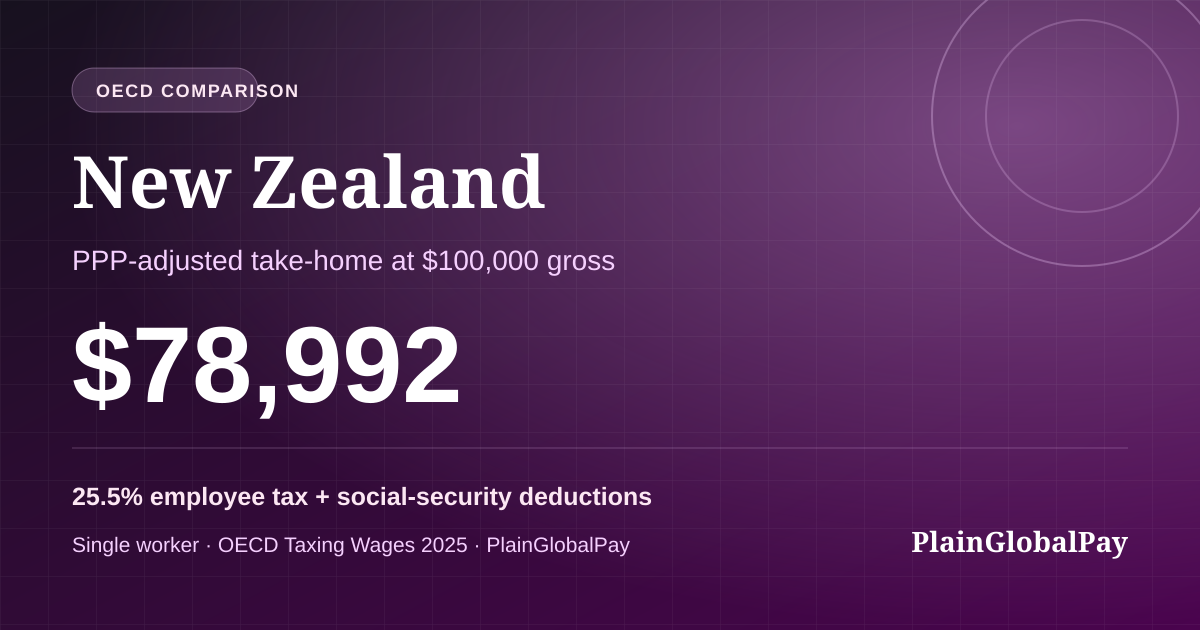
A $100,000 salary in New Zealand returns about $74,500 in annual take-home pay after employee tax and social-security deductions of 25.5%.
Adjusted for purchasing power, that take-home is worth $78,992 in real terms, ranking New Zealand #24 of 38 OECD countries (below the OECD average of $96,699). The effective income-tax rate is 25.5%. Figures from OECD Taxing Wages (2025 data) and the OECD PPP.
On PPP-adjusted take-home pay at a $100K gross salary, New Zealand ranks #24 of 38 OECD countries, higher than 37% of them. It sits below the OECD average of $96,699.
Country
New Zealand
Tax-data year
2025
Source
OECD
After income tax and employee social security contributions in New Zealand.
USD, after income tax + employee SSC
The $100,000 gross splits into take-home pay, income tax, and employee social security contributions.
Single, no children · OECD Taxing Wages (2025 data)
| Gross (USD) | Net (USD) | PPP-Adj Net | Eff. Tax Rate | Employee tax + SSC |
|---|---|---|---|---|
| $20,000 | $16,982 | $18,006 | 15.1% | 15.1% |
| $30,000 | $25,473 | $27,010 | 15.1% | 15.1% |
| $40,000 | $33,965 | $36,013 | 15.1% | 15.1% |
| $50,000 | $41,145 | $43,626 | 17.7% | 17.7% |
| $60,000 | $47,664 | $50,539 | 20.6% | 20.6% |
| $70,000 | $54,666 | $57,963 | 21.9% | 21.9% |
| $80,000 | $61,517 | $65,227 | 23.1% | 23.1% |
| $90,000 | $68,128 | $72,236 | 24.3% | 24.3% |
| $100,000reference | $74,500 | $78,992 | 25.5% | 25.5% |
| $110,000 | $81,726 | $86,654 | 25.7% | 25.7% |
| $120,000 | $89,156 | $94,532 | 25.7% | 25.7% |
| $130,000 | $96,585 | $102,410 | 25.7% | 25.7% |
| $140,000 | $104,015 | $110,287 | 25.7% | 25.7% |
| $150,000 | $111,445 | $118,165 | 25.7% | 25.7% |
| $160,000 | $113,782 | $120,644 | 28.9% | 28.9% |
| $170,000 | $119,966 | $127,200 | 29.4% | 29.4% |
| $180,000 | $126,040 | $133,640 | 30.0% | 30.0% |
| $190,000 | $132,005 | $139,965 | 30.5% | 30.5% |
| $200,000 | $137,861 | $146,174 | 31.1% | 31.1% |
| $210,000 | $143,608 | $152,268 | 31.6% | 31.6% |
| $220,000 | $149,245 | $158,245 | 32.2% | 32.2% |
| $230,000 | $154,773 | $164,107 | 32.7% | 32.7% |
| $240,000 | $160,193 | $169,853 | 33.3% | 33.3% |
| $250,000 | $165,503 | $175,483 | 33.8% | 33.8% |
| $260,000 | $170,704 | $180,998 | 34.3% | 34.3% |
| $270,000 | $175,795 | $186,396 | 34.9% | 34.9% |
| $280,000 | $181,969 | $192,942 | 35.0% | 35.0% |
| $290,000 | $188,468 | $199,833 | 35.0% | 35.0% |
| $300,000 | $194,967 | $206,724 | 35.0% | 35.0% |
Local currency per 1 USD PPP – OECD PPP
| Year | PPP Factor | Exchange Rate | Price Level Index |
|---|---|---|---|
| 1960 | 0.4817 | N/A | 67.4 |
| 1961 | 0.4603 | N/A | 64.3 |
| 1962 | 0.4770 | N/A | 66.3 |
| 1963 | 0.4801 | N/A | 66.8 |
| 1964 | 0.4907 | N/A | 68.2 |
| 1965 | 0.4870 | N/A | 67.7 |
| 1966 | 0.4593 | N/A | 63.9 |
| 1967 | 0.4853 | N/A | 66.1 |
| 1968 | 0.4897 | N/A | 54.8 |
| 1969 | 0.4699 | N/A | 52.6 |
These links use the same OECD single-worker model at a $100K gross salary, not geographic proximity or a recommendation.
New Zealand's tax system shapes the real value of every paycheck earned in the country. At a $100K USD equivalent salary, workers keep $74,500 after income tax and social security contributions, but when adjusted for local purchasing power, that take-home pay is worth $78,992 in US dollar terms. With a top marginal income tax rate of 39.0%, a VAT/GST rate of 15.0%, the total cost of employment and the net benefit to workers varies significantly compared to other OECD nations. Use the calculator above to model your own salary scenario.
At a $100K gross salary, New Zealand delivers $78,992 in PPP-adjusted take-home pay - $17,707 below the OECD average of $96,699. The nominal net figure of $74,500 understates or overstates what that salary actually buys because a dollar in New Zealand is not worth a dollar in the United States. The current PPP factor of 1.536 and price level index of 94.3 (US = 100) are the conversion mechanics that translate nominal pay into real living-standard units.
The top marginal income tax rate of 39.0% is only part of the picture, effective rates on typical salaries are much lower because of bracket progression, personal allowances, and family credits. At $100K, the effective income tax rate is 25.5% and employee tax plus social-security deductions are 25.5%. Employer-side social contributions add a layer of cost that does not appear on pay stubs but shifts the total cost of employment. On the spending side, a VAT/GST rate of 15.0% further reduces what each after-tax dollar ultimately purchases.
Compared to a US worker at the same $100K salary keeping $74,598 in PPP-adjusted terms, New Zealand delivers more real purchasing power per dollar of gross pay. The national average annual wage in New Zealand sits at $60,896 in PPP-adjusted US dollars, giving a baseline for how a $100K offer compares to typical local compensation, a premium or a discount depending on the market. The table of take-home pay and PPP factor history above shows how these forces have moved over time and at every salary level, so expat workers, remote employees, and employers can size a specific offer against the structural realities of New Zealand's tax and price landscape.
Step-by-step guide to using PPP for accurate salary comparison across countries.
Data-driven ranking of OECD countries by effective income tax burden and real take-home pay.
What the 15% global minimum corporate tax means for workers, companies, and countries.
Reuse the source-bounded OECD comparison card with a visible PlainGlobalPay attribution. The card is not personal tax advice.
Preview the embeddable cardDisclaimer: This information is provided for informational purposes only and does not constitute professional advice. Data is sourced from the OECD Taxing Wages database. Consult a qualified professional before making decisions based on this data.