Compiled by PlainGlobalPay, International Salary Comparison Editorial Process
Based on OECD Taxing Wages (2025 data), this page compares Turkey's modeled income tax, employee contributions, and take-home pay across the salary levels below. It is a standardized cross-country comparison, not a personal tax return, local tax quote, or average-income estimate.
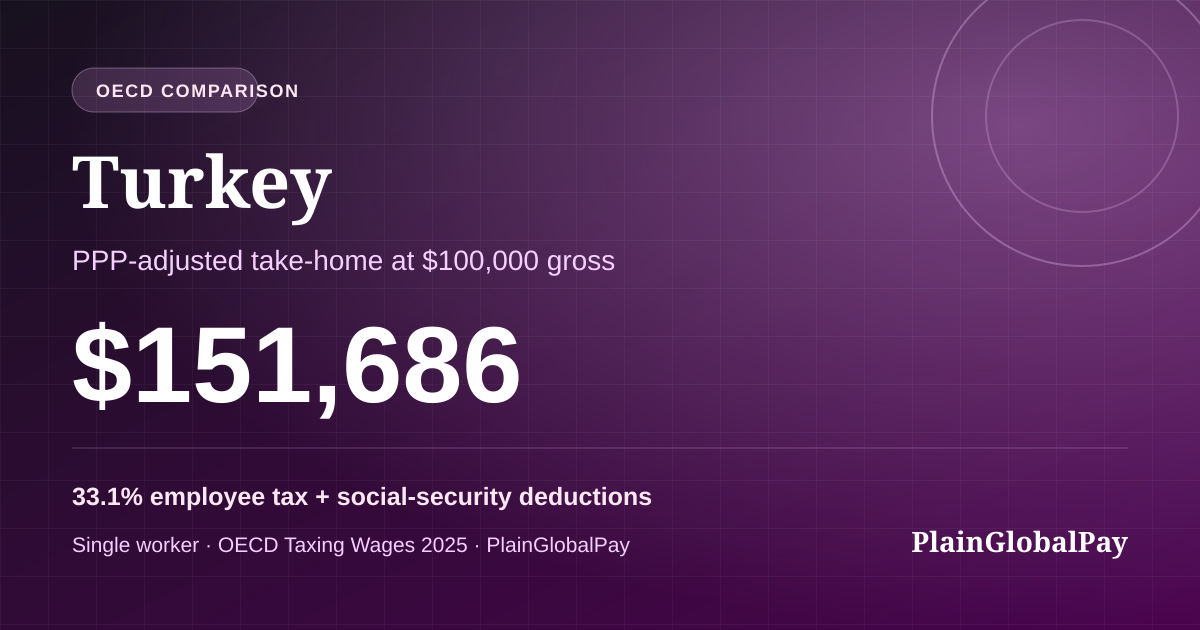
A $100,000 salary in Turkey returns about $66,935 in annual take-home pay after employee tax and social-security deductions of 33.1%.
Adjusted for purchasing power, that take-home is worth $151,686 in real terms, ranking Turkey #3 of 38 OECD countries (above the OECD average of $96,699). The effective income-tax rate is 18.1%. Figures from OECD Taxing Wages (2025 data) and the OECD PPP.
Gross $100K → Net
$66,935
Below OECD average
After income tax & SSC
PPP-Adjusted Net
$151,686
Above OECD average
Real purchasing power in USD
Effective Tax Rate
18.1%
Below OECD average
Income tax only
Employee tax + SSC
33.1%
Above OECD average
Income tax + employee SSC
Where Turkey ranks among the OECD
On PPP-adjusted take-home pay at a $100K gross salary, Turkey ranks #3 of 38 OECD countries, higher than 92% of them. It sits above the OECD average of $96,699.
lowest $59,682Turkeyhighest $227,332
Turkey in Its Region
Turkey plotted alongside other Europe OECD countries on the
PlainGlobalPay wage matrix. Horizontal axis is the country's combined employee tax and social-security deductions;
vertical axis is PPP-adjusted net pay at $100K gross.
Turkey (highlighted) against its Europe OECD peers, split by the region-average employee tax-and-SSC deduction rate (34.3%) and PPP take-home, which quadrant a country lands in tells you whether lower employee deductions, high purchasing power, or both are doing the work.
Turkey (highlighted) against its Europe OECD peers, split by the region-average employee tax-and-SSC deduction rate (34.3%) and PPP take-home, which quadrant a country lands in tells you whether lower employee deductions, high purchasing power, or both are doing the work.
Country
Turkey
Tax-data year
2025
Source
OECD
Take-home percentage at $100K66.9%
After income tax and employee social security contributions in Turkey.
Net take-home pay by salary in Turkey
USD, after income tax + employee SSC
Where a $100,000 salary goes in Turkey
The $100,000 gross splits into take-home pay, income tax, and employee social security contributions.
Turkey's tax system shapes the real value of every paycheck earned in the country.
At a $100K USD equivalent salary, workers keep $66,935 after income tax and social security contributions, but when adjusted for local purchasing power, that take-home pay is worth $151,686 in US dollar terms. With a top marginal income tax rate of 40.8%, a VAT/GST rate of 20.0%,
the total cost of employment and the net benefit to workers varies significantly compared to other OECD nations. Use the calculator above to model your own salary scenario.
What This Pay Data Actually Means for Workers in Turkey
At a $100K gross salary, Turkey delivers $151,686 in PPP-adjusted take-home pay - $54,987 above the OECD average of $96,699. The nominal net figure of $66,935 understates or overstates what that salary actually buys because a dollar in Turkey is not worth a dollar in the United States.
The top marginal income tax rate of 40.8% is only part of the picture, effective rates on typical salaries are much lower because of bracket progression, personal allowances, and family credits. At $100K, the effective income tax rate is 18.1% and employee tax plus social-security deductions are 33.1%. Employer-side social contributions add a layer of cost that does not appear on pay stubs but shifts the total cost of employment. On the spending side, a VAT/GST rate of 20.0% further reduces what each after-tax dollar ultimately purchases.
Compared to a US worker at the same $100K salary keeping $74,598 in PPP-adjusted terms, Turkey delivers more real purchasing power per dollar of gross pay. The national average annual wage in Turkey sits at $57,275 in PPP-adjusted US dollars, giving a baseline for how a $100K offer compares to typical local compensation, a premium or a discount depending on the market. The table of take-home pay and PPP factor history above shows how these forces have moved over time and at every salary level, so expat workers, remote employees, and employers can size a specific offer against the structural realities of Turkey's tax and price landscape.
Frequently Asked Questions
What is the income tax rate in Turkey?
Turkey has a top marginal income tax rate of 40.8%, compared with an OECD average employee tax-and-social-security deduction rate of 30.0%. At a $100K salary, the effective income tax rate is 18.1% and employee deductions (income tax plus employee social security contributions) reach 33.1%. Deductions that can lower the effective rate include standard personal allowances, employee social security contributions, and family-related credits where applicable. Use the calculator above to model your exact take-home pay at any salary level.
How does take-home pay in Turkey compare to other countries?
At a $100K USD equivalent salary, workers in Turkey keep $66,935 after income tax and social security contributions. Adjusted for local purchasing power using the PPP factor of 7.303, that take-home is worth $151,686 in real US dollar terms - $54,987 above the OECD average of $96,699. Compared to the United States ($74,598 PPP-adjusted), workers in Turkey get more real purchasing power per dollar earned.
Does Turkey have a VAT or sales tax?
Yes, Turkey levies a VAT/GST rate of 20.0%, which applies to most goods and services on top of income taxes. Many countries apply reduced rates to essentials like food, healthcare, and education. This consumption tax is not reflected in the take-home pay figures above, but it significantly affects real purchasing power, a 20.0% VAT means a moderate additional cost on everyday spending. The PPP factor already accounts for local price differences (including VAT effects) when converting take-home pay to real purchasing power.
What is purchasing power parity (PPP) and why does it matter for Turkey?
Purchasing power parity adjusts nominal salary figures to reflect what money actually buys in Turkey versus the United States. Turkey's PPP factor is 7.303, meaning the PPP adjustment is essential for accurate international salary comparison. The OECD PPP provides the conversion factors used here.
How much does an employer pay on top of salary in Turkey?
Employer social security contribution rates in Turkey vary by income level and program. These costs, which fund pensions, healthcare, and unemployment insurance, are invisible on a pay stub but increase the total cost of employment significantly. The OECD tax wedge includes employer contributions as well as income tax and employee social security contributions. This page's 33.1% employee deduction rate at a $100K salary excludes employer contributions, so it describes what leaves the worker's gross pay rather than the full employer cost.
How do I send money to or from Turkey?
International money transfers to Turkey (TRY) involve exchange rate margins, transfer fees, and processing time that vary by provider. The PPP factor and exchange rate shown above help estimate the real value of remittances, a dollar sent from the US may buy a different amount of goods in Turkey than at home. Use the PPP-adjusted take-home figures above to estimate what those funds are worth in local terms.
What is the difference between the effective tax rate and employee deductions in Turkey?
The effective income tax rate counts only income tax as a share of gross pay. The employee deduction rate adds employee social-security contributions, so it better reflects what leaves a paycheck. Both are shown above for a $100K salary in Turkey; the gap between them is the employee social-security share. The OECD tax wedge is broader because it also includes employer contributions.
What deductions or credits lower the effective tax rate in Turkey?
The effective rate shown for Turkey already reflects the standard deductions in the OECD Taxing Wages model: the basic personal allowance, deductible employee social-security contributions, and family-related credits where they apply. Individual circumstances such as additional dependents or country-specific reliefs can lower the rate further; the figures here use the OECD stylized single-worker case.
How does family status change take-home pay in Turkey?
Like every OECD member, Turkey adjusts take-home pay for family circumstances. A single worker with no children typically faces the highest effective rate, while a married single-earner couple with two children usually pays less because of child credits and spousal allowances. PlainGlobalPay models three OECD family types at every salary level.
Disclaimer: This information is provided for informational purposes only and does not constitute professional advice. Data is sourced from the OECD Taxing Wages database. Consult a qualified professional before making decisions based on this data.